Finding Your Ideal Match: What Ancient Wisdom Teaches
Finding a compatible life partner is one of life’s most significant decisions, yet the criteria for true compatibility are often misunderstood. While modern ...
Finding a compatible life partner is one of life’s most significant decisions, yet the criteria for true compatibility are often misunderstood. While modern approaches to matchmaking emphasize emotional connection and shared interests but our ancient Indian wisdom traditions offer a more comprehensive framework that addresses multiple dimensions of human compatibility.
This isn’t about rejecting modern approaches. It’s about reclaiming forgotten knowledge that addressed human compatibility at every level such as physical, mental, spiritual, and karmic.
Why Do We Truly Seek Partnership?
When people describe what they want in a partner, they typically mention:
- Companionship and emotional support
- Someone to share a life with
- A sense of home, a place where they can be their authentic self
- Shared growth and happiness
- Building a family together
These desires are valid and beautiful, but they’re surface-level like the branches of a tree visible but not the whole picture.
The deeper purpose of marriage, according to ancient tradition, extends beyond personal fulfilment. It’s about honouring past generations and nurturing the future ones, thereby strengthening the fabric of humanity, community, society and nation.
This broader understanding helps contextualize why compatibility matters, the partnership isn’t just about two individuals, but about the larger web of human connection they’re part of.
The Foundation: Understanding Physical Compatibility
Here’s something uncomfortable that most modern matchmaking completely skips: physical compatibility matters, and it matters more than we admit.
Ancient Indian texts describe this world as Maithoon Srishti (“copulative creation”), recognizing that all living organisms arise through sexual union. Far from being taboo, sexuality was understood as fundamental to existence so much so that approx 42 texts on Kamasutra (the science of desire and intimacy) were created.
The scriptures teach that in the material world, one of the highest states of pleasure and fulfillment comes through intimate union between compatible partners. (Yogis who attain Atmagyaan (self-realization) experience bliss 1,000 times greater during deep meditation. But that is beyond the scope of this article, will cover in different article.)
For most people, this drive for connection, intimacy exists whether we acknowledge it or not. Even people who claim they’re not seeking partnership will feel a subtle loneliness, or catch themselves comparing their lives to couples around them, wondering what they’re missing.
The Basic Principle: Height Matters
A man should ideally be 2–3 inches taller than his partner. This isn’t about social norms; it’s anatomy. The female reproductive system sits lower in the body, and this height difference allows natural alignment during intimacy.
The Body Type Classification System
The ancient texts categorize four types of women and four types of men based on their physical constitution and needs:
Four Types of Women:
- Padmini (Lotus Woman):
- Gentle nature, higher need for emotional connection and affection (approximately 25% physical need, 75% emotional).
- Face pleasing as the full moon, soft body, skin fine and fair as yellow lotus
- Walks like a flamingo (swan), waist with three folds, voice resembles goose or cuckoo
- When drinking water we can see the nerves in neck because of soft delicate skin
- Red corners of eyes
- Bosom hard, full and high
- Neck shaped like conch-shell
2. Chitrini (Art Woman): Balanced in both physical and emotional needs (~50/50 split)
- Middle size, neither short nor tall, bee-black hair, thin round shell-like neck, tender body, waist lean-girthed, hard full breasts, well-turned thighs, heavily made hips
- Neck like conch shell, slightly triangular face, fond of singing and dancing, attracted to intellect.
- Voice like peacock
- Walk like elephant swing (coquettish gait)
3. Shankhini (Conch Woman): Passionate and warm nature, balanced needs, potentially fiery temperament
- Bilious temperament, skin always hot and tawny or dark yellow-brown, large body, thick waist, small breasts, thin and long head, hands and feet
- Stretched body, long neck resembling crane, spread toes and feet, long waist, unusually tall
- Looks out of corners of eyes
- Voice hoarse and harsh
- Bone cage clearly visible in neck
4. Hastini (Elephant Woman): Strong, voluptuous, with high physical energy and intensity needs (75%+) and moderate emotional needs (25%)
- Short stature, stout coarse body, dead white or sallow-white skin, tawny hair, large lips, voice harsh choked and throaty, neck bent
- Slower gait, feet clumsy and small, neck fleshy, breasts big and swollen, walks like elephant
- Usually short height
- Robust build
Four Types of Men:
- Shasha (Hare, size ~ 3inch): Gentle, with lower physical intensity needs (25%) and higher emotional connection needs (75%)
- Short and spare figure but well-proportioned, small hands, knees, feet, loins and thighs, thighs darker than rest of skin
- Round or square face, small appetite, clean chest, silky hair, small but well-proportioned hands, reddish and graceful palm, pale face color
- Clear, well-proportioned features
- Round face, short fine teeth
- Large, well-opened eyes
- Quiet disposition
2. Vrishabh (Bull, size ~ 4–6inch): Balanced in physical and emotional needs (~50/50)
- Robust and tough body like tortoise, fleshy chest, hard belly, frogs of upper arms turned to be brought in front, high forehead, large long eyes with pink corners, red palms
- Medium to stocky build
- Strong, aggressive features
3. Ashwa (Horse, size ~ 5–7inch): Moderate to high physical needs (~50%+) balanced with emotional connection
- Tall and large-framed but not fleshy, body hard as iron, broad full muscular chest, body below hips is long, mouth and teeth long, neck and ears long, hands and fingers remarkably long
- Knees somewhat crooked
- Nails of toes also crooked
- Hair long, coarse and thick
- Fixed hard look
- Deep voice like bull
4. Gadha (Donkey): Very high physical intensity needs (80%+) with lower emotional needs (20%)
More about this you can search on web and at the end of the article, I have added few links.
Why Physical Mismatch Creates Serious Problems
Imagine a Padmini woman (high emotional needs, lower physical intensity) married to a Gadha or Ashwa man (very high physical intensity needs). What happens? both suffer:
- She may experience physical discomfort or even illness from the mismatch
- He will likely never feel truly satisfied and may unconsciously seek fulfillment elsewhere
- She craves the deep emotional connection he’s less equipped to provide
- Both partners end up feeling something essential is missing
- The risk of looking outside the marriage increases
The wise person understands that these characteristics exist on a spectrum and aren’t rigidly defined. The Kamasutra includes extensive guidance on positions, timing, and techniques for couples with different body types to better harmonize their intimate life.
This is why physical compatibility is often more foundational than mental compatibility alone.
What We’ve Lost
In traditional communities, a Purohit (priest/matchmaker) knew every family intimately over years of interaction. Through years of observing families at community events and gatherings, these matchmakers could assess compatibility across multiple dimensions like physical, familial, temperamental, and cultural, which could facilitate successful matches.
Additionally, traditional life created natural interdependence, men and women relied on each other’s complementary strengths, fostering mutual respect and partnership.
Today, especially in metropolitan areas, we’ve lost this holistic assessment system. We swipe based on photos and bios. We meet for coffee and judge chemistry through conversation. We’ve become experts at evaluating mental compatibility while remaining blind to physical compatibility until after commitment.
I want to be absolutely clear: I am not suggesting that people should check sexual compatibility before marriage through physical relations. That would go against traditional values and create more problems than it solves.
What I am sharing is that the ancient scriptures provided ways to assess physical compatibility without intimate contact but by observing body structure, proportions, and physical characteristics.
Each of the four types has distinct body features that can be identified through careful, respectful observation of:
- Overall body frame and height
- Facial structure and features, Neck shape and thickness
- Hand and finger proportions
- Hip and thigh structure
- Voice quality
- Gait and manner of walking
- General temperament and energy
The Other Essential Dimensions
Family Compatibility: The Unseen Influence
You cannot truly know a family’s values, communication patterns, and unspoken rules through a few meetings or even six months of courtship. Family culture runs deep, shaped over generations.
Traditionally, communities held regular festivals, celebrations, and gatherings where families interacted naturally over years. This organic observation allowed parents to understand other families’ dynamics thoroughly before arranging marriages between their children.
The modern problem: In Tier 1 cities, families are often isolated. You meet your partner’s family briefly, on their best behavior, in artificial settings. Then you marry and discover completely different conflict resolution styles, financial attitudes, or parenting philosophies.
The solution: If possible, observe your potential partner’s family in various settings. How they behave in stressful situations, their daily routines, how they celebrate. Notice how they handle disagreements. Watch how they treat service staff, elders, and children. These patterns reveal what you’ll be joining.
Financial Compatibility: The Practical Foundation
Compared to other dimensions, financial compatibility is relatively straightforward to assess:
- What are your individual money philosophies (saver vs. spender)?
- What are your shared financial goals?
- How do you handle financial stress or disagreements?
- Are you aligned on lifestyle expectations?
Have explicit conversations about money before marriage. It’s not romantic, but financial stress is one of the leading causes of marital discord.
Spiritual Compatibility: The Shared Path
Spiritual compatibility involves alignment of beliefs, values, and practices. It provides a unified lens for navigating life’s inevitable challenges.
Most traditional cultures are built around spiritual or religious rituals. When one partner doesn’t understand, respect, or participate in these practices, friction develops. One partner may feel their identity is being dismissed while the other feels pressured to conform.
Shared spiritual practices create:
- Deeper bonding and connection
- A sense of sacred purpose beyond daily routines
- Built-in reflection and renewal practices
- Trust that comes from joint devotion to something greater
You don’t need identical beliefs, but you need respect, curiosity, and willingness to support each other’s spiritual journey.
Mental and Behavioral Compatibility: The Daily Reality
This is what most modern couples focus on and it certainly matters. Mental compatibility can be assessed through conversations about:
- Core values and life priorities
- Communication styles and conflict resolution approaches
- Hobbies, interests, and how you spend free time
- Attachment styles (anxious, avoidant, secure)
- Love languages (words, touch, acts of service, gifts, quality time)
- Individual goals, dreams, and definitions of success
- Lifestyle preferences (social vs. private, adventurous vs. routine)
The internet offers countless resources and questions for assessing mental compatibility.
Critical timing insight: During the first 1–2 months, the intoxication of infatuation clouds judgment. Your brain is literally flooded with chemicals that make you overlook red flags.
If you maintain some distance for a week or two after the initial intensity, that chemical rush fades. Suddenly you’ll see the real person more clearly their green flags and their red ones, making it easier to see potential challenges clearly.
Understanding Life Needs: The Maslow Framework
One overlooked compatibility factor involves where each person sits on Maslow’s hierarchy of needs:
The Hierarchy (from bottom to top):
- Physical body needs (food, shelter, safety, body senses pleasure)
- Security needs (financial stability, health)
- Love and belonging (relationships, community)
- Esteem and status (achievement, recognition)
- Self-actualization (purpose, growth, spirituality)
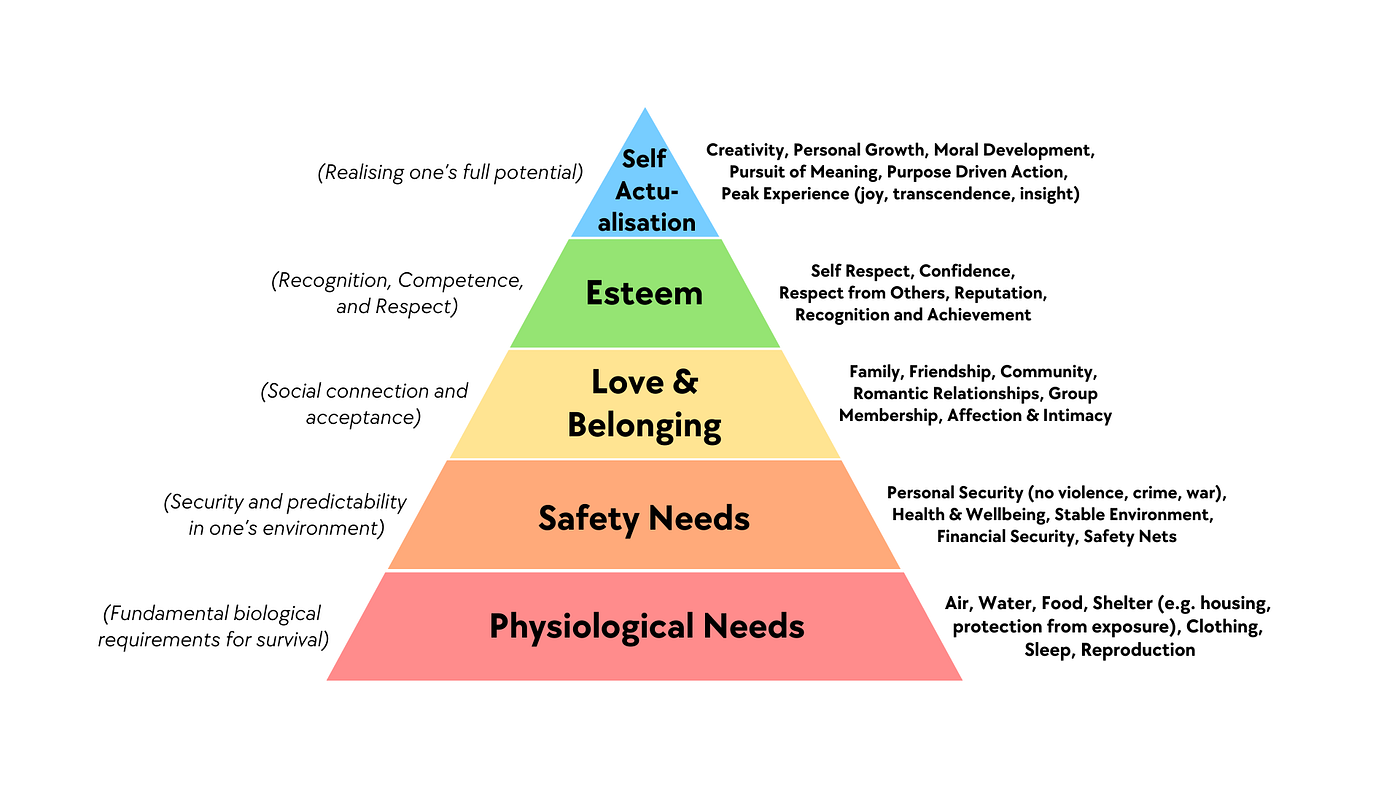 Diagram from Wikipedia.com
Here’s the key insight: The pyramid reflects reality. Most people operate primarily from the bottom levels, seeking senses pleasure, safety and security. Fewer people reach the top, focused on self-actualization and spiritual seeking.
The compatibility problem: When partners operate from vastly different levels, chronic friction develops.
Example: Someone seeking self-actualization (exploring philosophy, meditation, personal growth) marries someone focused primarily on physical security and status (career advancement, material accumulation, social standing).
What happens? The higher-seeking partner must either:
- Lower their consciousness to meet the partner where they are, or
- Attempt to elevate their partner to their level which is extremely difficult and often creates resentment
Neither solution is sustainable. The constant mismatch in priorities leads to feeling unseen, unheard, and fundamentally misunderstood.
Check for aligned life stage needs and goals when you first meet. This single conversation can reveal whether you’re building toward the same destination or simply traveling parallel paths that will eventually diverge.
The Role of Kundali and Karma
In Hindu tradition, checking Kundali (birth charts) for compatibility is standard practice. Should you dismiss it as superstition?
Not entirely. Astrological compatibility has value and shouldn’t be completely ignored. However, we also cannot claim it guarantees marital success karma ultimately shapes how life unfolds.
Consider this example from the Ramayana itself: Lord Rama and Mata Sita’s marriage was performed with all proper rituals by Yogavashishtha, one of the greatest sages and an expert in these matters. Their Kundalis were perfectly aligned.
Yet after marriage, their lives took an unexpected turn. Mata Sita, who had lived in royal luxury, was forced to leave the palace and live in the forest in the most basic conditions. Later, she faced even greater trials.
The lesson: Even with perfect astrological alignment and expert guidance, karma creates its own path. Life brings challenges that no chart can prevent.
Use Kundali matching as one data point among many, not as the sole determinant. Your actions, choices, and how you navigate challenges together matter far more than planetary positions.
Bringing It All Together: The Complete Compatibility Picture
After observing many relationships, here’s what I’ve learned is No single dimension of compatibility is sufficient, and no single incompatibility is necessarily fatal. A person who is willing to grow, has empathy and has understanding nature will always try his/her best to save the relationship and sacrifice for greater good.
A comprehensive assessment includes:
Physical compatibility is the foundation. Without it, dissatisfaction festers beneath the surface, eventually manifesting as chronic tension, affairs, or inexplicable unhappiness despite “having everything.”
Spiritual alignment provides shared meaning and purpose beyond daily routines. It’s the difference between building a life together versus simply coexisting.
Mental and emotional compatibility determines whether daily life feels easy or exhausting, whether you feel seen or invisible.
Family and financial alignment removes major sources of ongoing stress and conflict.
Aligned life needs and goals ensure you’re walking the same path, not just parallel ones.
When you find someone compatible across all these dimensions, you create the conditions for something rare: a marriage that not only survives but genuinely thrives.
You build a relationship characterized by:
- Deep satisfaction at every level
- Mutual growth and evolution
- Minimal chronic conflict
- Genuine partnership and support
- Love that deepens rather than fades
A Final Reflection
The search for a life partner is perhaps the most important decision you’ll make. It deserves wisdom, honesty, and thorough awareness.
The rising incidence of extramarital affairs suggests that physical compatibility deserves more attention than it typically receives in modern matchmaking. When spiritual compatibility and genuine empathy are also present, couples significantly increase their chances of building a fulfilling, lasting marriage.
Traditional wisdom offers valuable frameworks for thinking about compatibility, though these should complement rather than replace modern understanding of consent, communication, emotional intelligence, and mutual respect.
Check all the dimensions. Be honest about mismatches. Don’t assume love or commitment will magically resolve fundamental incompatibilities.
You need alignment of body, mind, spirit, family culture, and life purpose.
And if you’re already married and recognizing areas of incompatibility? All is not lost. Awareness is the first step. With conscious effort, empathy, and sometimes professional guidance, couples can bridge gaps they never knew existed.
What dimensions of compatibility did you consider before committing to your partner? What do you wish you’d known? Share your insights in the comments your experience might illuminate someone else’s path.
Refrences
https://burtoniana.org/books/1885-Ananga%20Ranga/1885-Ananga%20Ranga.htm